Responsible Dog Ownership: What It Actually Looks Like Day to Day
Responsible Dog Ownership Day falls on 19 September, and it is one of those awareness days that could easily turn into a lecture. We would rather it did not. Almost everyone reading this already loves their dog and is doing their best. Responsible dog ownership is not a test you pass or fail, it is a set of small, ordinary habits that add up over a dog’s lifetime.
So instead of a list of rules, here is an honest look at what responsible dog ownership involves day to day, including the bits people tend to forget.
The Legal Side of Responsible Dog Ownership (Quicker Than You Think)
Microchipping and Keeping Details Current
All dogs in the UK must be microchipped by eight weeks old and registered on an approved database. Most owners have this covered. What far fewer people have covered is the second half of the requirement, and it is the part responsible dog ownership really hinges on: keeping the registered details up to date.
A microchip with an old mobile number or a previous address on it is close to useless. Every year, dogs are picked up, scanned, and then sit in kennels because nobody can reach the owner. If you have moved house or changed your number since you got your dog, take five minutes this week and update it. The GOV.UK guidance on microchipping explains how.
Your Dog Needs a Tag Too
The Control of Dogs Order still requires a collar and tag with your name and address on it when your dog is in a public place. A microchip does not replace it. A tag gets your dog home from the next street in ten minutes rather than via a vet, a scanner and a phone call.
Exercise That Suits the Dog in Front of You
There is a lot of noise online about how much exercise a dog needs, and much of it is unhelpful. A young collie and an elderly pug do not want the same day.
Responsible dog ownership means matching exercise to breed, age and health rather than to a number you read somewhere. It also means recognising that physical exercise is only half the picture. A dog who has spent twenty minutes sniffing along a hedgerow is often more settled afterwards than one who has run flat out for an hour. Sniffing is genuinely tiring in the best way.
Puppies need particular care here, because overexercising growing joints causes real damage. Our puppy care visits are built around short, age appropriate sessions for exactly this reason.
Training Is a Kindness, Not a Vanity Project
A dog who understands what is expected of them is a more relaxed dog.
The genuinely useful skills are:
- A reliable recall
- Walking without pulling
- A solid sit and wait
- Settling calmly indoors
- Being comfortable with handling and grooming
None of these are show off skills. They are the things that let your dog come with you to more places and have more freedom when they get there.
Reward based training is what we use and what every major UK welfare organisation recommends.
Being a Good Neighbour
This is the most visible side of responsible dog ownership, and it shapes how the rest of the world feels about dogs, so it matters more than it might seem.
Pick It Up, Every Time
Including in long grass. Including when nobody is watching. Including at dusk when it is genuinely a faff. Dog fouling is the single biggest reason communities push for restrictions on where dogs can go.
Read the Room on Lead Use
Not every dog wants to meet your dog, and not every person is comfortable with a friendly one bounding over. The lead goes on around livestock, near roads, on nature reserves during ground nesting season and anywhere the signs ask you to. “He’s friendly” does not help the person backing away.
Barking
A dog who barks for hours while you are at work is usually not being naughty. They are bored, anxious or both. It is worth taking seriously, for your dog’s sake as much as your neighbours’.
Responsible Dog Ownership When You Are Not There
Here is the part that gets the least airtime. Most of us work. Most dogs are not built to be alone for eight or nine hours at a stretch, and pretending otherwise does not make it true.
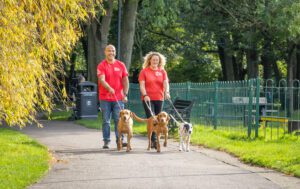
Being responsible about this means being honest about your week and putting cover in place. That might be a family member, it might be a neighbour, or it might be a professional. Our dog walking service breaks up the working day, and for holidays our dog home boarding puts your dog in a real family home rather than a kennel block.
Whoever you use, it is worth checking they are:
- Fully insured
- DBS checked
- Licensed where the service requires it
- Happy to meet your dog before the first booking
Every We Love Pets branch ticks all four, and each one is run by someone local who has met the dogs on their books personally.
Health You Can Actually Keep On Top Of
Health is the quietest part of responsible dog ownership, and the basics, kept up consistently, do most of the work:
- An annual vet check
- Vaccinations up to date
- Year round flea and worm treatment
- Teeth looked after
- Weight kept sensible
That last one is the quiet epidemic in UK dogs, and it takes years off their lives. If you are not sure whether your dog is a healthy weight, ask your vet to show you how to body score them. It takes two minutes and it is a useful thing to know.
The Point of the Day
Responsible dog ownership is mostly unglamorous. It is updating a microchip record, carrying an extra poo bag, putting the lead on when you would rather not, and arranging cover for a Tuesday when you are stuck at work. Do those things consistently and your dog has a very good life.
We Love Pets Is Here to Help
Responsible dog ownership is a great deal easier with a hand on the days when work gets in the way. Find your local We Love Pets branch and speak to the team. And if this is the kind of work you would love to do yourself, take a look at our franchise opportunities.